
Conquering the Countertop: 7 Essential Tips for Mastering Dough
Stop fearing yeast! Discover 7 essential tips for mastering dough at home. From the "windowpane test" to handling sticky dough without the mess
Let’s be honest: for a lot of home cooks, working with dough is intimidating. There’s something about yeast living ingredient—that feels a little unpredictable. Will it rise? Will it be tough? Will it turn into a sticky mess that I have to scrape off the ceiling?
I’ve been there. I have cried over flat focaccia and wrestled with brioche that refused to behave. But after years of dusting my kitchen in flour, I’ve learned that dough isn’t magic—it’s just science and a little bit of intuition.
Whether you are making a simple Friday night pizza crust or diving into the world of sourdough, here are my top tips to help you stop fearing the dough and start loving the process.
1. Ditch the Cups, Buy a Scale
If you take only one tip away from this post, let it be this one. Baking is chemistry. If you scoop flour with a measuring cup, you might be packing in 20% more flour than the recipe calls for, resulting in a dry, dense brick.
- The Fix: Invest in a digital kitchen scale. Measuring by grams is faster (less washing up!) and guarantees that your hydration ratios are exactly where they need to be.
2. The "Baby Bottle" Rule for Yeast
Yeast is fussy about temperature. If your water is too cold, the yeast won't wake up. If it's too hot, you'll kill it.
- The Trick: Aim for "blood warm." When you dip your finger into the water or milk, it should feel neutral—neither hot nor cold. If you’re unsure, lean cooler; yeast will eventually rise in cool water, but it will never recover from boiling water.
3. Sticky is Good (Usually)
A common instinct when dough sticks to your hands is to panic and throw more flour at it. Resist this urge. Adding raw flour during the kneading process changes the hydration of your dough, often making the final product tough and dry.
- Pro Tip: Instead of flouring your hands, try wetting them with water or lightly oiling them. Dough doesn't stick to wet hands! If the dough is sticking to the counter, use a bench scraper to manipulate it rather than adding more flour.
4. Respect the "Autolyse"
This sounds fancy, but it’s actually the lazy baker’s secret weapon. After you mix your flour and water (before adding salt or yeast, usually), let it sit for 20–30 minutes.
- Why it works: This pause allows the flour to fully hydrate and the gluten network to start forming on its own. You’ll find the dough is much easier to knead and more extensible afterward.
5. Watch the Dough, Not the Clock
Recipes lie. Well, they don't mean to, but a recipe that says "let rise for 1 hour" doesn't know that your kitchen is drafty and 65°F (18°C), while the recipe developer's kitchen was a humid 75°F (24°C).
- The Fix: Use visual cues. Most recipes want the dough to "double in size." Mark the level of your dough on the side of the container with a dry erase marker or a rubber band so you can actually see when it has doubled, regardless of how long it takes.
6. The Windowpane Test
How do you know when you’ve kneaded enough? If you stop too soon, your bread won’t have structure. If you go too long (rare by hand, common with mixers), you break the mesh.
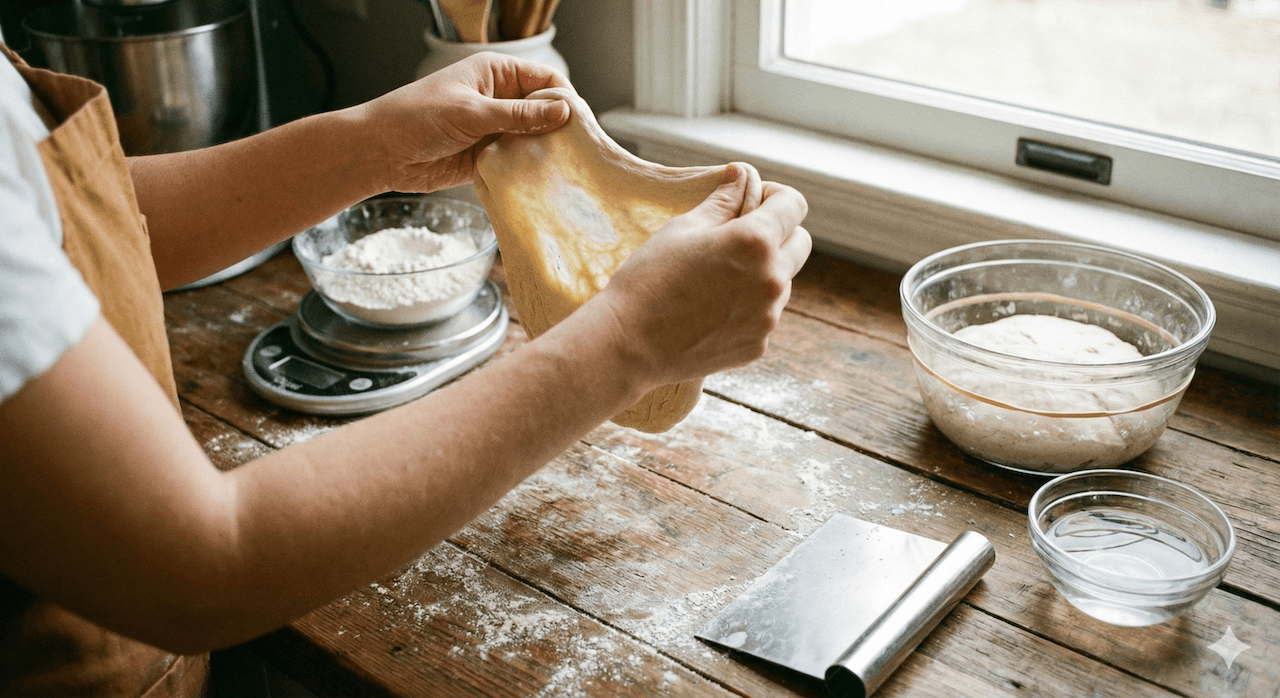
- The Test: Tear off a small piece of dough and gently stretch it between your fingers. If you can stretch it thin enough to see light through it without it tearing, your gluten is developed. If it rips immediately, keep kneading.
7. The Poke Test for Proofing
Knowing exactly when to put the loaf in the oven is the final hurdle. Under-proofed bread will burst open; over-proofed bread will deflate.
- The Test: Gently poke the rising dough with your knuckle.
- Springs back instantly? It needs more time.
- Stays indented and doesn't move? It might be overproofed (bake immediately!).
- Springs back slowly and leaves a small dent? It is perfect. Bake it now.
Final Thoughts
Dough can smell fear, so approach it with confidence! Even your "failures" will still taste like warm, homemade bread, and there is nothing better than that.
Tell me in the comments: What is the one bake that you are too scared to try? Maybe we can tackle it together next week!